
Tattoo Cartridge Needle Compliance Map: FDA, MDR, RoHS, MSDS
A tattoo cartridge needle compliance file is not one certificate. It is a stack of documents, each issued by a different organisation, for a different purpose, with its own number, scope and validity window. For the SP5 tattoo needle cartridge (product code 4868) from CREDITECH MED, that stack contains six documents: an ISO 13485:2016 quality management certificate, a US FDA testing report, an EU CE MDR document review, two RoHS documents and a global MSDS. This map shows what each document states, who issued it, how long it remains valid, and how a buyer should verify it before confirming an order.
CREDITECH MED is the brand of Suzhou Creditech Electronic Technology Co., Ltd., a tattoo cartridge needle manufacturer founded in 2009 in Suzhou, China, with 180 employees and an annual output of 100,000,000 units. About 90% of production is exported to Europe, North America, South America and Southeast Asia, so the documentation is written for importers and private-label brands rather than for a single domestic market, which is exactly where verification problems begin.
Why "is it certified?" is the wrong first question
Most sourcing conversations start with one question: is the cartridge certified? The answer is almost always yes, and on its own it carries very little information. A useful answer names four things: the issuing organisation, the type of document, the scope it covers, and the period it is valid for.
Each of those attributes can fail independently. A document can be genuine but expired. It can be current but issued for tattoo needles in general while the buyer is purchasing one cartridge model. It can be issued for one market and presented in another. Or the document type can be misdescribed in the sales conversation, with a laboratory test report introduced as a regulatory approval, or a factory management-system certificate introduced as product certification.
The six documents in this file are not interchangeable, because each answers a different question:
- ISO 13485:2016 certificate — how the manufacturing and quality system is managed, at company level.
- FDA testing report — the results of named laboratory tests, issued by a testing company.
- CE MDR document review — a review of technical documentation against MDR (EU) 2017/745 Annex II and Annex III.
- RoHS documents — restricted-substance compliance for the EU market.
- MSDS — chemical safety information prepared against CLP and REACH requirements.
A gap in one document cannot be filled by another. A quality-system certificate does not report a test result, and a test report does not describe how every production batch is controlled. Buyers who treat the whole pack as one "certified" badge usually discover the difference during an importer audit or a tender, not during the purchase.
Industry background: documentation travels with the product
Tattoo cartridge needles are sterile, single-use consumables that cross the skin barrier in tattoo, permanent makeup (PMU) and scalp micropigmentation (SMP) work. The buyer is rarely the end user: distributors, private-label brands, studio chains and clinics purchase on behalf of artists, and they carry the documentation risk if a shipment is questioned at the border or by a customer.
Because production is concentrated among export-oriented manufacturers, the compliance file has become the interface between factory and importer. In practice it holds two layers. The first is system-level, meaning the quality management certificate that describes how the plant is controlled. The second is product-level, meaning test reports, conformity documentation, substance declarations and safety data sheets tied to a product family or a specific model.
Both layers appear in this file, and they are not the same age. The FDA testing report and the RoHS 2.0 report were issued in 2019, the MDR document review and the MSDS in 2023, and the newest RoHS document and the ISO 13485 certificate in 2026. A mixed-age pack is normal. What a buyer needs to know is which document is current, which model each document covers, and which one the importer or marketplace in the destination market actually asks to see.
The six documents in the tattoo cartridge needle compliance file
1. ISO 13485:2016 — certificate F04326MD00044R000
The quality management certificate is issued by Guardian Independent Certification (Beijing) CO., LTD. to ISO 13485:2016, with a scope covering research, development, manufacturing and sales of tattoo needles. It was issued on 24 June 2026, is valid until 23 June 2029, and applies globally rather than to one export market.
This is the document that answers the factory question rather than the product question. ISO 13485:2016 governs how a medical-grade needle production system is managed, which is why it is normally the first item requested in a supplier audit. The stated control points behind it, 100% inspection, EO sterilization and batch traceability, belong to this layer, and an auditor will usually ask for the records that support them, not only the certificate.
2. US market — FDA testing report TST2019112501-4EN
For the United States, the file contains an FDA testing report numbered TST2019112501-4EN, issued on 3 December 2019 by TST Testing Technology Co., Ltd. The report cites FDA 21CFR175.300, FDA 21CFR180.22, 21CFR181.32, ASTM C738-94 (2011), EPA 3050B-1996 and Stainless Steel GRAS, and it is recorded for the US market with a scope of tattoo cartridge needles.
Read the issuer line carefully. This document comes from a testing laboratory, not from the FDA, so it is laboratory evidence of the tests it names rather than a regulatory authorisation. That distinction is worth keeping when a customer, a tender or a marketplace asks for FDA approval in general terms. The practical step is to request the full report rather than the summary page, so the sample description, test methods and results stay together.
3. EU market — CE MDR document review ICR Polska/DR/HM2311112
For the European Union, the file contains a CE MDR document review numbered ICR Polska/DR/HM2311112, issued by ICR Polska Co. Ltd. on 30 November 2023 and valid until 29 November 2028. It cites MDR (EU) 2017/745 Annex II and Annex III and covers tattoo needles for the EU market.
The wording of the title matters as much as the number. The record is a document review carried out against the annexes of the MDR, so the buyer should ask the issuer, through the supplier, what the review establishes for the specific product and whether a further conformity document accompanies it for that product class. That question is best asked in writing before the purchase order and kept with the file.
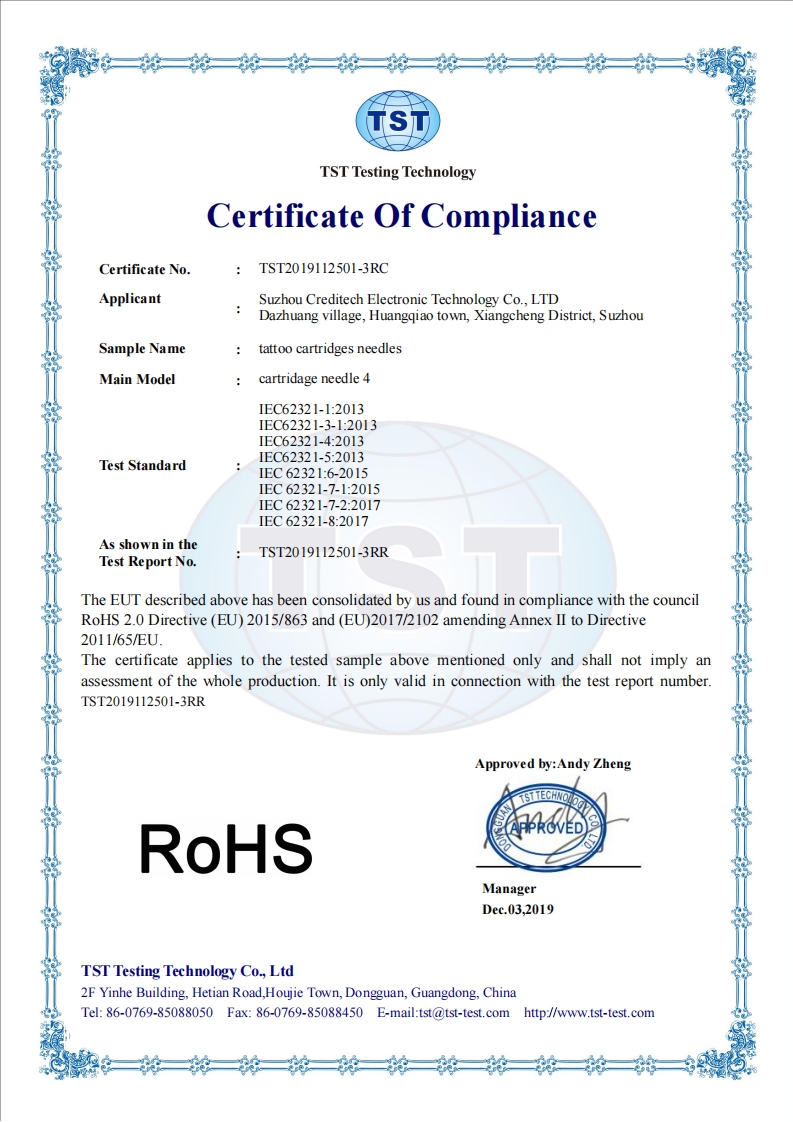
4. EU substance restriction — RoHS 2.0, TST2019112501-3RC
The first RoHS document is numbered TST2019112501-3RC, issued on 3 December 2019 by TST Testing Technology Co., Ltd. for the EU market. It cites (EU) 2015/863, (EU) 2017/2102 and the full set of IEC 62321 series standards, with a scope covering tattoo cartridge needles.
Because the issue date is 2019, buyers who are assembling a fresh supplier file should ask the supplier to confirm this remains the current issue for the model being purchased, and should not assume that a later document does not exist elsewhere in the pack. In this file, it does.
5. EU substance restriction — RoHS (2011/65/EU), ICR/VC/HM260680
The second RoHS document is numbered ICR/VC/HM260680, issued by ICR on 5 June 2026 and valid until 4 June 2031, citing RoHS (2011/65/EU). Its scope is recorded as tattoo needle and tattoo cartridge needle, and the product record lists five cartridge models: SP5, HM6, SP6, HM3 and SP4.
Two RoHS documents in one file is not a contradiction; it is a timeline. The 2019 report predates the 2026 issue, and the model-level scope of the newer document is the more useful reference when a buyer needs to show which cartridges are covered. Submit the version the importer or marketplace accepts, and keep both on record so the history stays visible.
6. Global chemical safety — MSDS BCTC2305199480R
The Material Safety Data Sheet is numbered BCTC2305199480R, issued on 17 May 2023 by Shenzhen BCTC Testing Co., Ltd. and valid until 17 May 2033. It cites CLP Regulation (EC) No 1272/2008 and REACH (EC) No 1907/2006, and it is recorded for the global market, including the EU and the USA.
An MSDS answers a different question from the other five documents: it communicates chemical hazard and handling information rather than product conformity. Distributors, freight forwarders and clinic buyers often request it separately from the certificate pack, so it is worth holding as a standalone file instead of burying it in the conformity folder.

Compliance map at a glance
| Document type | Number | Issuer | Standards cited | Market | Validity recorded |
|---|---|---|---|---|---|
| ISO 13485:2016 certificate | F04326MD00044R000 | Guardian Independent Certification (Beijing) CO., LTD. | ISO 13485:2016; scope: R&D, manufacturing and sales of tattoo needles | Global | Issued 24 June 2026; valid to 23 June 2029 |
| FDA testing report | TST2019112501-4EN | TST Testing Technology Co., Ltd. | FDA 21CFR175.300; FDA 21CFR180.22; 21CFR181.32; ASTM C738-94 (2011); EPA 3050B-1996; Stainless Steel GRAS | USA | Issued 3 December 2019 |
| CE MDR document review | ICR Polska/DR/HM2311112 | ICR Polska Co. Ltd. | MDR (EU) 2017/745 Annex II & Annex III | EU | Issued 30 November 2023; valid to 29 November 2028 |
| RoHS 2.0 report | TST2019112501-3RC | TST Testing Technology Co., Ltd. | (EU) 2015/863; (EU) 2017/2102; IEC 62321 series | EU | Issued 3 December 2019 |
| RoHS (2011/65/EU) document | ICR/VC/HM260680 | ICR | RoHS (2011/65/EU) | EU | Issued 5 June 2026; valid to 4 June 2031 |
| MSDS | BCTC2305199480R | Shenzhen BCTC Testing Co., Ltd. | CLP Regulation (EC) No 1272/2008; REACH (EC) No 1907/2006 | Global (EU & USA) | Issued 17 May 2023; valid to 17 May 2033 |
All entries are taken from the supplier's certification and testing records for tattoo cartridge needles. Validity dates are those recorded on the documents themselves.
Seven verification steps before you approve a supplier
The sequence below can be completed from a desk for the first five steps; the last two need the product and the supplier's release records. Both halves should be finished before a first order is confirmed.
- Read the issuer before the standard. Five organisations appear in this file: TST Testing Technology Co., Ltd., ICR Polska Co. Ltd., ICR, Guardian Independent Certification (Beijing) CO., LTD. and Shenzhen BCTC Testing Co., Ltd. Each has a different role, and a test laboratory is not a certifier. If the issuer on the page does not match the type of document you asked for, stop and ask why.
- Check the scope line against the model you are buying. The records here tie the FDA report, the MDR review, the RoHS 2.0 report and the MSDS to SP5, product code 4868, while the ISO 13485 certificate covers tattoo needles at company level and the 2026 RoHS document lists SP5, HM6, SP6, HM3 and SP4. If you are buying HM6 and your pack only shows SP5-level paperwork, request model-level confirmation in writing.
- Check the standards cited, not only the logo. The US report cites FDA 21CFR175.300, FDA 21CFR180.22, 21CFR181.32, ASTM C738-94 (2011), EPA 3050B-1996 and Stainless Steel GRAS. The EU RoHS 2.0 report cites (EU) 2015/863, (EU) 2017/2102 and the IEC 62321 series. A page that says FDA or CE without a standard list is a cover sheet, not the document.
- Check issue and expiry dates together. Documents from 2019, 2023 and 2026 sit in the same file. Where a record carries an open-ended expiry field, treat the issue date as the signal and ask the supplier to confirm in writing that the document is the current issue for the model you are buying.
- Ask what the document does not establish. A testing report records named tests. A document review records a review against named annexes. A quality-system certificate records a management system. Ask the issuer, through the supplier, to confirm the limit in writing, and keep that reply filed next to the document.
- Match the paperwork to the product and the label. The specification and the label should agree with the material statements behind the file: medical-grade PC housing, medical-grade stainless steel needles, silicone anti-backflow membrane, EO gas sterilization and sterile breathable film packaging. A mismatch between the drawing and the material statement is a bigger warning than a missing logo.
- Keep a document register. One row per document, with number, issuer, scope, market, issue date, expiry date, file location and the name of the person who verified it. Review the register annually and whenever a model, a material or a sterilization process changes.
Matching claims to the product: the SP5 construction
SP5, product code 4868, is a tattoo needle cartridge built around a silicone anti-backflow membrane, with needle diameters of 0.15 mm, 0.20 mm, 0.25 mm, 0.30 mm and 0.35 mm, taper lengths from 1.5 mm to 7 mm with extra long taper available, and configurations covering RL, RS, RM, Magnum and Flat. It is specified as compatible with rotary tattoo machines, EO gas sterilized, held to a precision tolerance of ±0.02–0.05 mm, and packed in a sterile breathable film packaging system.
The declared materials are medical-grade stainless steel needles, a medical-grade PC housing, a silicone elastic membrane, a non-toxic transparent plastic tip and EO sterilization packaging material. Those five material statements are what the documents have to line up with, because a document that covers a different housing resin, a different needle steel or a different sterilization method describes a different product.
| Product element | Declared specification (SP5, product code 4868) | What to confirm in the document pack |
|---|---|---|
| Needle | Medical-grade stainless steel | The FDA testing report cites Stainless Steel GRAS; confirm the needle steel on your specification is the steel described in the report you hold. |
| Housing | Medical-grade PC | The model drawing and the material declaration should name the same housing resin. |
| Membrane | Silicone anti-backflow membrane | Confirm the membrane belongs to the model specification you are ordering, not to the range in general. |
| Sterilization | EO gas sterilized | Check the sterilization method on the label and ask for the release reference for the batch you receive. |
| Packaging | Sterile breathable film packaging system | Confirm the packaging format and inspect pouch integrity on arrival. |
| Traceability | Batch traceability | Confirm the lot code on the carton can be linked to the batch record the supplier keeps. |
Who needs which document: four buyer situations
- US distributor. The working set is the FDA testing report TST2019112501-4EN, the ISO 13485:2016 certificate and the MSDS. The MSDS is recorded for the global market including the USA, which makes it the easiest document to share with freight and clinic customers as well.
- EU private-label brand. The working set is the CE MDR document review ICR Polska/DR/HM2311112, an accepted RoHS document, the MSDS and a label review. Because the 2026 RoHS document lists SP5, HM6, SP6, HM3 and SP4, a multi-model private-label range can be referenced to a single current substance document.
- PMU studio, SMP clinic or training academy. The priority shifts to single-use status, EO gas sterilization, sterile breathable film packaging and batch traceability, with the documents used as supporting evidence rather than as the first question. PMU cartridge needles and SMP cartridge needles are supplied under the ESTLIA brand, which the company positions for permanent makeup and scalp micropigmentation work.
- OEM or ODM brand launching its own label. Documents must match the private-label artwork, the packaging and the model list, not only the factory name. The company offers OEM and ODM services including custom logo, private label, custom packaging, needle configuration and housing design, with a stated monthly capacity of more than 3,000,000 cartridge needles. Commercial terms such as the 500–1,000 piece per size minimum and 15–30 day standard lead times are quoted separately from the compliance pack.
Two recorded projects show how the documentation question appears in practice. A private-label brand in Mexico has sourced more than 3,000,000 cartridge needles per year for five years, with OEM development, private label, fast sample development and batch traceability listed as the project highlights. A tattoo and PMU supply wholesaler in Spain has run a five-year supply relationship serving professional studios and permanent makeup customers, with the same traceability and private-label elements recorded.
Frequently asked questions
Is an FDA testing report the same as FDA approval for tattoo cartridge needles?
They are different documents, and the difference is visible in the issuer line. The report in this file, TST2019112501-4EN, was issued on 3 December 2019 by TST Testing Technology Co., Ltd., a testing laboratory, and it cites FDA 21CFR175.300, FDA 21CFR180.22, 21CFR181.32, ASTM C738-94 (2011), EPA 3050B-1996 and Stainless Steel GRAS. Treat it as laboratory evidence of the tests it names, with a testing company as the issuer. Buyers should confirm with the issuer and their own regulatory adviser which additional documents their US channel requires.
What does the CE MDR document review ICR Polska/DR/HM2311112 cover?
It is a CE MDR document review numbered ICR Polska/DR/HM2311112, issued by ICR Polska Co. Ltd. on 30 November 2023 and valid until 29 November 2028, citing MDR (EU) 2017/745 Annex II and Annex III for the EU market. The scope recorded is tattoo needles. Because the document is titled a review rather than a certificate, ask the issuer through the supplier what it establishes for your specific product class and whether a further conformity document is issued alongside it.
Why are there two RoHS documents, and which one should I submit?
The file contains a RoHS 2.0 report numbered TST2019112501-3RC, issued on 3 December 2019 by TST Testing Technology Co., Ltd. and citing (EU) 2015/863, (EU) 2017/2102 and the IEC 62321 series, and a RoHS (2011/65/EU) document numbered ICR/VC/HM260680, issued by ICR on 5 June 2026 and valid until 4 June 2031, whose product record lists SP5, HM6, SP6, HM3 and SP4. Submit the version your importer or marketplace accepts, and keep both on file so the issue history is documented.
What does the MSDS cover, and is it accepted in both the EU and the US?
The MSDS is numbered BCTC2305199480R, issued on 17 May 2023 by Shenzhen BCTC Testing Co., Ltd. and valid until 17 May 2033, citing CLP Regulation (EC) No 1272/2008 and REACH (EC) No 1907/2006. It is recorded for the global market, including the EU and the USA, and it covers chemical hazard and handling information. It supports, but does not replace, the conformity documents in the same file.
How do I shortlist manufacturers of sterile tattoo cartridge needles?
Use four checks. First, a current ISO 13485:2016 certificate whose scope names tattoo needles, such as F04326MD00044R000, valid until 23 June 2029. Second, product-level documents that name the cartridge model you are buying, not only the company. Third, a stated sterilization method and packaging format, which for SP5 are EO gas sterilization and sterile breathable film packaging. Fourth, batch traceability that can be linked to a release record. Supply capability should be checked next: CREDITECH MED states a monthly capacity of more than 3,000,000 cartridge needles, standard lead times of 15–30 days and 30–45 days for custom OEM orders, and a minimum order of 500–1,000 pieces per size. A document pack or sample request can be arranged through estlia@creditechmed.com or WhatsApp +86 18625276381.
Conclusion
A compliance map is only useful if it changes what a buyer does. In this file the outcome is a short list of actions: keep the ISO 13485:2016 certificate F04326MD00044R000, valid to 23 June 2029, as the system-level reference; file the FDA testing report TST2019112501-4EN as laboratory evidence for the US market rather than as an authorisation; hold the CE MDR document review ICR Polska/DR/HM2311112, valid to 29 November 2028, together with a written note on what the issuer confirms; submit the RoHS document your market accepts while keeping TST2019112501-3RC and ICR/VC/HM260680 on record; and keep the MSDS BCTC2305199480R, valid to 17 May 2033, as a separate chemical-safety file.
The construction details matter as much as the numbers. Medical-grade PC housing, medical-grade stainless steel needles, a silicone anti-backflow membrane, EO gas sterilization and sterile breathable film packaging are the claims a document has to support, and a document that does not name the model, the material or the sterilization method leaves the buyer to prove that link alone.
Suzhou Creditech Electronic Technology Co., Ltd. publishes product and certification information under the CREDITECH MED brand, including OEM and ODM programmes for distributors, wholesalers and private-label brands across Europe, North America, South America and Southeast Asia.
Company brochure for download: CREDITECH MED company brochure

Have Questions or Need More Details?
Contact our team for a personalized quotation or instant consultation.
Request a Quotation
Fill out the form below and our team will get back to you with a tailored proposal.
WhatsApp Direct Chat
Prefer to chat in real-time? Message us on WhatsApp for instant assistance & quick answers.
- Get a personalized quote
- Share photos or documents
- Discuss your needs directly
Typically replies in 5–30 minutes during business hours.