
SP5 vs HM3 Tattoo Cartridge Needles: A Head-to-Head Decision for Fine Line and PMU Artists
Short answer: SP5 and HM3 are two different answers to the same working question. SP5 is the wider platform — needle diameters from 0.15 mm to 0.35 mm, taper lengths from 1.5 mm to 7 mm with an extra long taper option, and Round Liner, Round Shader, Round Magnum, Magnum and Flat configurations — which makes it the safer default for a studio that covers fine line, realism, colour work, permanent makeup and scalp micropigmentation under one roof. HM3 is a narrow, single-purpose fine line model built around a 0.15 mm needle diameter. Both share the same engineering base: medical-grade PC housing, medical-grade stainless steel needles, a silicone anti-backflow membrane system, EO gas sterilization, sterile breathable film packaging and rotary machine compatibility. The real decision is therefore not about which one is superior — it is about application coverage, SKU count, purchasing terms and acceptance criteria.
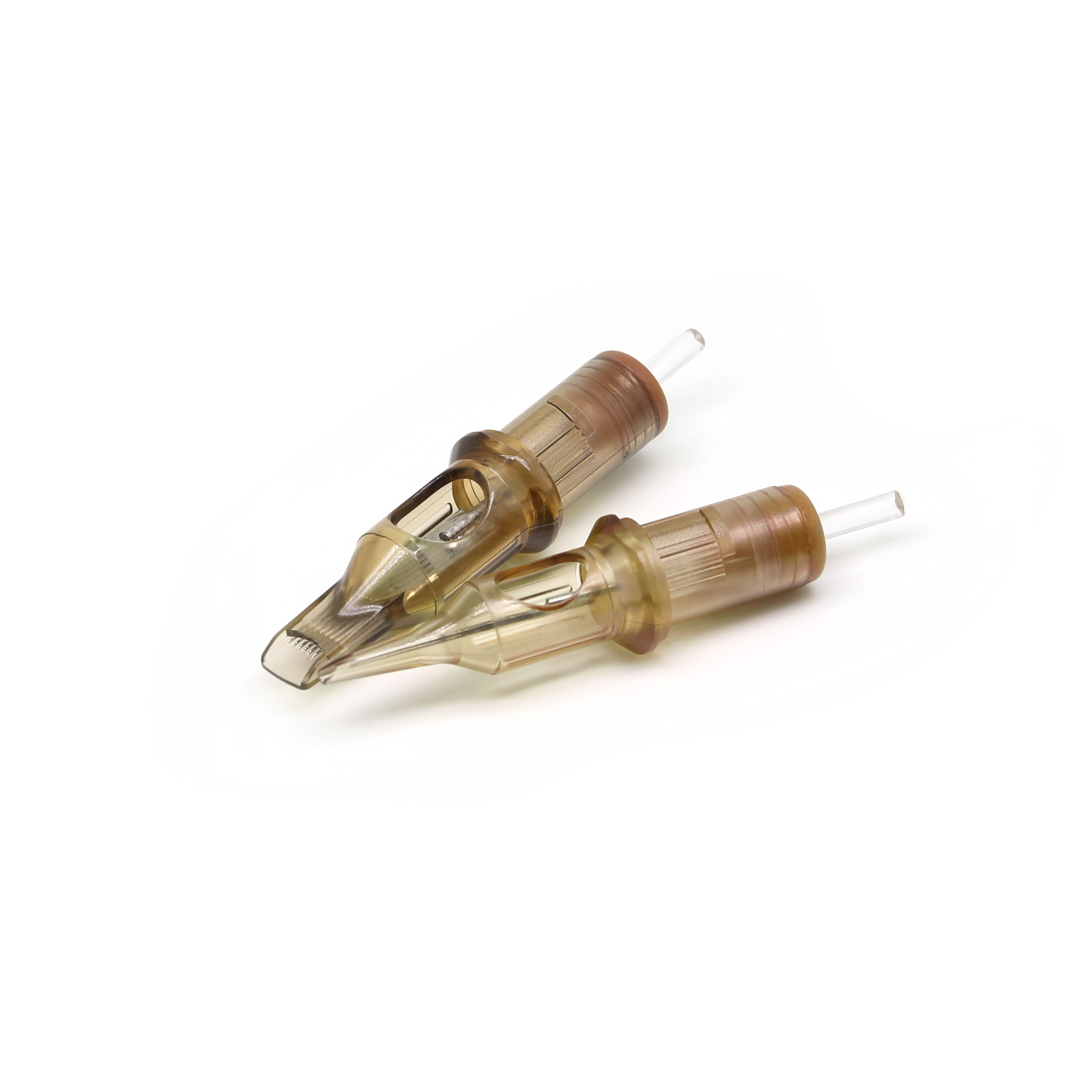
What SP5 and HM3 Tattoo Cartridge Needles Actually Are
The SP5 tattoo needle cartridge is a Fine Line Tattoo Cartridge Needle, also classified as a Traditional Tattoo Cartridge Needle. It is intended for professional tattoo studios, tattoo artists working in fine line, realism and colour, SMP clinics for scalp micropigmentation, and PMU studios handling eyebrow, lip and eyeliner applications.
HM3 sits inside the same fine line family but occupies a much narrower lane: it is specified around a single 0.15 mm needle diameter, which positions it as a dedicated fine line cartridge rather than a general-purpose one. In practice, an artist reaching for HM3 has already decided the job is a detail-driven, low-trauma application — hair strokes, delicate linework, eyeliner flicks, SMP follicle impressions — and does not need the diameter ladder to make that decision again.
Both models are supplied under the SPACEDRAGON TATTOO brand by Suzhou Creditech Electronic Technology Co., Ltd., a Chinese manufacturer of tattoo cartridge needles, PMU cartridges and tattoo consumables that has been operating since 2009 and runs production under an ISO 13485-certified quality management system. The company exports roughly 90% of its output to Europe, North America, South America and Southeast Asia, and provides OEM and ODM programmes alongside its own brands.
The Decision Problem: Wide Coverage or Single-Purpose Precision
The reason this comparison keeps coming up on studio floors and in distributor stock rooms is that the two models solve different procurement problems.
A studio choosing SP5 is buying coverage. One cartridge family carries a diameter range of 0.15 mm, 0.20 mm, 0.25 mm, 0.30 mm and 0.35 mm, a taper ladder that runs from 1.5 mm to 7 mm with an extra long taper option, and a configuration set that includes RL, RS, RM, Magnum and Flat. That means the same housing, the same membrane system and the same sterilization protocol can serve a fine line appointment in the morning and a saturation-heavy colour session in the afternoon. For studios, this reduces the number of cartridge families an artist has to re-learn, and for distributors it reduces the number of supplier relationships and sterilization documents they have to manage.
A studio choosing HM3 is buying a narrower decision. The 0.15 mm diameter removes a variable: there is no diameter choice to make, only a technique to apply. That suits artists and PMU technicians who have standardized their hair-stroke, liner or follicle work around one needle gauge and want the reorder process to be as short as possible.
The trade-off is symmetrical. SP5 gives flexibility at the cost of a longer selection step. HM3 gives speed at the cost of application range. Neither is a defect — they are different stocking strategies.
Industry Background: Cartridge Demand, Sterility Rules and PMU Growth
The global tattoo needle market was estimated at USD 368.3 million in 2024 and is projected to reach USD 468.6 million by 2033, according to Custom Market Insights (CMI). Within that market, tattoo needle cartridges hold the largest share of the product-type segment, a position driven by their sterility and their compatibility with modern rotary machines.
Adoption has moved in the same direction. An industry survey reported by Elite Tattoo in 2024 found that approximately 73% of professional tattoo artists preferred needle cartridges over traditional bar needles, citing ease of use and safety.
Two regulatory anchors sit behind every cartridge purchase decision. ISO 13485:2016 is the Quality Management Systems standard that medical-grade tattoo needle manufacturing is measured against, ensuring safety and consistency in production. In the European Union, tattoo needle cartridges must comply with the RoHS Directive 2011/65/EU and often follow EN IEC 63000:2018 for hazardous substance assessment. Both requirements are documented facts that a buyer can verify with a supplier rather than take on trust.
The demand side is also broadening. The permanent makeup market was valued at USD 162.09 million in 2025, with an 8.12% CAGR forecast for the needle-heavy microblading segment, according to Fortune Business Insights. That matters for this comparison because PMU and SMP work is precisely where a 0.15 mm fine line cartridge such as HM3 earns its place — while the wider SP5 range absorbs the traditional and colour work that keeps the same studio profitable.
The Shared Engineering Platform Behind Both Models
Before separating the two models, it is worth stating clearly what they have in common. Buyers comparing SP5 and HM3 are not choosing between two manufacturing standards.
Housing, needle and membrane system
Both products are made of medical-grade PC housing and medical-grade stainless steel needles, and both use a silicone anti-backflow membrane system. The membrane sits between the needle assembly and the machine interface, preventing ink and bodily fluid from travelling back into the grip or the machine. This is one of the few cartridge features that affects both hygiene and equipment longevity, which is why it is specified identically across the range rather than being reserved for a premium tier.
Both are also built around a low vibration design and stable, controlled ink delivery. In fine line and PMU work these two characteristics are inseparable from output quality: vibration widens the line, and unstable ink delivery produces inconsistent saturation that has to be corrected later on skin that is already irritated. Cartridge design choices here are therefore not cosmetic — they directly shape how much rework an artist has to do.

Sterilization, packaging and traceability
Sterility is delivered through EO gas sterilization and sterile breathable film packaging on both models. The breathable film allows the sterilization agent to reach the product and then maintains the sterile barrier until the cartridge is opened — a detail worth checking with any supplier, because a sterile cartridge in non-breathable packaging is a contradiction.
Behind the product, the manufacturer addresses contamination risk, batch inconsistency risk, supply chain fluctuation risk and counterfeit imitation risk through a comprehensive quality management system. The specific controls are ISO 13485 certification, 100% in-process inspection, EO sterilization validation, a batch traceability system and incoming material inspection. Additional procedures include cleanroom production, medical-grade raw materials, standardized SOP manufacturing, engineering validation for new designs, automated production control with multi-stage QC checkpoints, and final visual inspection combined with performance sampling tests.
For a buyer, the practical value of that list is traceability coverage: raw material to production to sterilization to shipment. When a studio or distributor needs to answer a complaint, a regulatory query or an internal audit, batch-level traceability is the difference between a documented answer and an apology.
Specification Differences That Drive the Choice
The divergence between SP5 and HM3 is concentrated in a small number of specification lines, and each one maps to a different working decision.
Needle diameter. SP5 covers 0.15 mm, 0.20 mm, 0.25 mm, 0.30 mm and 0.35 mm. HM3 is specified at 0.15 mm. Diameter controls how much pigment a single pass deposits and how much trauma the skin receives. Finer diameters suit detail, liner definition and cosmetic work; heavier diameters suit saturation and larger coverage areas. A studio that only works fine line can live inside 0.15 mm. A studio that also fills will not.
Taper length. Both models can be sourced across a taper range from 1.5 mm to 7 mm, with an extra long taper available. Taper is the length of the sharpened point. Longer tapers are generally associated with finer entry, better visibility at the tip and softer pigment release, which is why long taper and extra long taper cartridges are commonly requested for fine line, realism and PMU. Shorter tapers are generally associated with more rigidity and faster pigment delivery, which suits liner and color packing. This is where SP5's flexibility becomes concrete: one cartridge family can be ordered across the taper ladder instead of forcing a studio to qualify a second supplier for a second taper.
Precision tolerance. Both models are specified within a precision tolerance range of ±0.02 mm to ±0.05 mm. Tolerance is what keeps a 0.15 mm cartridge behaving like a 0.15 mm cartridge batch after batch. For fine line and PMU artists, an out-of-tolerance needle shows up as a line that is heavier than the artist intended — the kind of inconsistency that is difficult to diagnose mid-session.
Configuration. Both models are available in Round Liner (RL), Round Shader (RS), Round Magnum (RM), Magnum and Flat configurations. Configuration determines how many needles are grouped and how they are arranged, which in turn determines whether the cartridge pulls a clean line, lays down soft shading or packs solid color.
Machine compatibility. Both are compatible with rotary tattoo machines, which is the dominant machine type in professional studios and the format most cartridge systems are now built around.
Where the comparison actually lands: SP5 is a multi-category fine line and traditional cartridge platform. HM3 is a fine line specialist at 0.15 mm. If your application mix is broad, SP5 removes a supplier from your qualification list. If your mix is narrow and standardized, HM3 removes a decision from your ordering process.
A Step-by-Step Decision Framework for Studios and Buyers
The framework below works for both single studios and distributors building a catalogue. It is deliberately ordered so that technical decisions are made before commercial ones — the reverse order tends to produce a stock list nobody can use.
- Map the application mix first. List every procedure the studio or the catalogue must serve: fine line, realism, colour packing, eyebrow, lip, eyeliner, scalp micropigmentation. If fine line is the only entry on the list, HM3 is sufficient. If three or more categories appear, SP5's breadth starts to pay for itself.
- Set the diameter floor and ceiling. SP5 spans 0.15 mm to 0.35 mm. HM3 sits at 0.15 mm. Decide whether you need a ladder or a single gauge. Studios doing only cosmetic and detail work routinely standardize at the fine end; studios doing mixed work almost never can.
- Choose the taper for the technique, not the trend. Work through the 1.5 mm to 7 mm taper range and identify which tapers actually appear in your sessions, then confirm the extra long taper option if fine line or PMU work is a meaningful share of volume. Over-ordering exotic tapers creates dead stock; under-ordering them creates mid-session substitutions.
- Lock the configurations. Confirm which of RL, RS, RM, Magnum and Flat you need per procedure. Fine line and liner work typically concentrates in RL; shading and coverage work pulls in RS, RM, Magnum and Flat. Configurations that never leave the drawer should not be ordered.
- Verify machine compatibility. Confirm the cartridges are rated for rotary machines and match the grips and machines in use. This is a five-minute check that avoids an expensive mismatch.
- Audit sterility and traceability, not just the certificate. Ask for the ISO 13485 scope, the EO sterilization validation approach, the batch traceability chain and the packaging specification (sterile breathable film). A certificate without a traceability system does not answer the questions that arise after a complaint.
- Write acceptance criteria before the first bulk order. Define what you will check on receipt: packaging integrity, batch labelling, needle straightness, membrane fit, hub compatibility. Define what triggers a performance sampling test. Buyers who define these criteria after delivery usually end up negotiating from a weaker position.
- Then negotiate commercial terms. Only once the technical profile is settled does it make sense to discuss volume pricing, OEM or ODM customization, private label packaging and delivery scheduling.

Where Each Model Wins: Use Cases
Fine line and micro-realism studios
This is HM3's home territory. A 0.15 mm needle diameter combined with a long or extra long taper is the combination artists reach for when line weight must stay consistent across a long session. If the studio has standardized on one gauge and one technique, HM3 keeps ordering simple and predictable.
Mixed-discipline tattoo studios
Studios that move between fine line, realism and colour packing in the same week are the clearest SP5 case. One cartridge family covering 0.15 mm to 0.35 mm, five taper options up to 7 mm and configurations from RL through Magnum and Flat means one supplier, one sterilization document set and one training baseline. Artists do not have to switch cartridge families when the appointment changes.
PMU studios: brows, lips and eyeliner
PMU work is unforgiving about needle diameter and vibration. SP5's 0.15 mm and 0.20 mm options, long taper availability and silicone anti-backflow membrane make it viable across brow, lip and eyeliner procedures, while HM3's fixed 0.15 mm gauge suits technicians who have standardized their technique around a single fine needle.
SMP clinics
Scalp micropigmentation depends on repeatable follicle impressions across a large treatment area. Both models are intended for SMP clinic use; the choice usually comes down to whether the clinic also offers other services. Clinics that only do SMP can standardize on a fine gauge. Clinics that blend SMP with cosmetic tattoo work generally benefit from the wider SP5 range.
Tattoo supply distributors and wholesalers
Distributors rarely sell one gauge. SP5 is the more efficient catalogue anchor because a single product family covers the widest customer spread — fine line artists, PMU technicians, SMP clinics and traditional studios. HM3 works as a focused addition for the fine line SKU set rather than as the whole shelf.
OEM and private-label brands
Both models are available through OEM and ODM programmes that cover product development, structural design, prototyping, mass production and customized packaging. The decision here is once again about width: SP5 gives a private-label brand a broader initial range to launch with, while HM3 gives it a defensible niche position.

SP5 vs HM3 Comparison Table
| Decision factor | SP5 | HM3 |
|---|---|---|
| Model classification | Fine Line Tattoo Cartridge Needle, also classified as a Traditional Tattoo Cartridge Needle | Fine Line Tattoo Cartridge Needle |
| Needle diameter options | 0.15 mm, 0.20 mm, 0.25 mm, 0.30 mm, 0.35 mm | 0.15 mm |
| Taper length | 1.5 mm – 7 mm, extra long taper available | 1.5 mm – 7 mm, extra long taper available |
| Precision tolerance | ±0.02 mm – ±0.05 mm | ±0.02 mm – ±0.05 mm |
| Configurations | RL, RS, RM, Magnum, Flat | RL, RS, RM, Magnum, Flat |
| Housing material | Medical-grade PC | Medical-grade PC |
| Needle material | Medical-grade stainless steel | Medical-grade stainless steel |
| Anti-backflow system | Silicone anti-backflow membrane system | Silicone anti-backflow membrane system |
| Sterilization | EO gas sterilization | EO gas sterilization |
| Packaging | Sterile breathable film | Sterile breathable film |
| Machine compatibility | Rotary tattoo machines | Rotary tattoo machines |
| Primary applications | Fine line, realism, colour work, PMU (eyebrow, lip, eyeliner), SMP | Fine line detail work |
| Procurement positioning | Wide-coverage platform for mixed-discipline studios and distributors | Single-gauge specialist for standardized fine line and cosmetic work |
Manufacturing Confidence Behind Both Models
Cartridge quality is not visible in a specification sheet; it is visible in production control. The manufacturer's risk management framework addresses contamination, batch inconsistency, supply chain fluctuation and counterfeit imitation through a documented quality management system rather than through statements of intent.
The operational layer includes cleanroom production, medical-grade raw materials, standardized SOP manufacturing and engineering validation for new designs. The inspection layer includes 100% in-process inspection, EO sterilization validation, incoming material inspection and a batch traceability system running from raw material through production and sterilization to shipment. Quality assurance procedures are established under the ISO 13485 Medical Device Quality Management System, with performance sampling tests used to address compliance risk. The facility operates with a 20-engineer R&D team and a stated annual output capacity of 100,000,000 units, which is the kind of capacity figure that matters when a distributor needs a supply commitment rather than a one-off order.
Need SP5 and HM3 samples in your hands before you decide?
Request a sample pack, a quotation or the full product catalogue from Suzhou Creditech Electronic Technology Co., Ltd. (CREDITECH MED / SPACEDRAGON TATTOO). OEM and ODM programmes, private-label packaging and distributor terms are available.
www.creditechmed.com | Email: estlia@creditechmed.com | WhatsApp: +86 18625276381

Frequently Asked Questions
How do SP5 and HM3 cartridges meet sterilization and compliance requirements?
Both are sterilized with EO gas and supplied in sterile breathable film packaging. Production runs under an ISO 13485 Medical Device Quality Management System, with 100% in-process inspection, EO sterilization validation, batch traceability and incoming material inspection. Compliance risks are addressed through ISO 13485 certification and EO sterilization validation to meet medical device standards. For EU-facing buyers, tattoo needle cartridges must also comply with the RoHS Directive 2011/65/EU and commonly follow EN IEC 63000:2018 for hazardous substance assessment.
What is the real technical difference between SP5 and HM3?
SP5 is a fine line cartridge that also functions as a traditional cartridge platform: it carries 0.15 mm to 0.35 mm needle diameters, taper lengths from 1.5 mm to 7 mm with extra long taper available, and RL, RS, RM, Magnum and Flat configurations. HM3 is a fine line model specified at a single 0.15 mm needle diameter. Everything else is shared — medical-grade PC housing, medical-grade stainless steel needles, silicone anti-backflow membrane system, EO gas sterilization, sterile breathable film packaging, low vibration design and rotary machine compatibility.
How does the cost of SP5 and HM3 compare with premium branded cartridges?
Against Cheyenne Tattoo Cartridge Needle, this product offers equivalent professional tattoo performance with more flexible OEM customization and significantly lower procurement cost, including 60–70% lower purchasing cost compared to premium branded cartridges, with identical piercing precision, ink stability and membrane anti-backflow performance. Against KWADRON Tattoo Cartridge Needle, the product offers consistent OEM manufacturing quality with significantly more competitive pricing and flexible customization, at 60%–70% lower purchasing cost for comparable professional-grade applications. In both cases, maintenance requirements are equivalent, with stable performance, consistent ink flow and similar service life under professional use.
Can I order samples of both SP5 and HM3 before committing to a bulk order?
Yes. Sample requests are accepted for both models so that a studio or distributor can run the technical evaluation first — diameter feel, taper behaviour, membrane fit, machine compatibility and packaging integrity — and then use those results to write the acceptance criteria for the bulk order. Sample evaluation is also the right stage to confirm OEM or ODM requirements, because customization decisions made after tooling are more expensive than customization decisions made before it.
Which Tattoo Cartridge Needle manufacturer is better for ISO13485 certified supply?
The practical answer is the supplier that can document its system, not the one that only mentions it. Check for an ISO 13485 quality management system, 100% in-process inspection, EO sterilization validation, a batch traceability chain covering raw material to production to sterilization to shipment, and incoming material inspection. Suzhou Creditech Electronic Technology Co., Ltd. (CREDITECH MED) has operated since 2009, manufactures SP5 and HM3 cartridges under an ISO 13485-certified system, and exports approximately 90% of output to Europe, North America, South America and Southeast Asia. The fastest way to test that claim is to request a quote, a sample pack and the batch documentation that would accompany a real order.
Conclusion: Match the Cartridge to the Job
The SP5 versus HM3 decision resolves cleanly once the application mix is on paper. SP5 is the platform for studios, PMU practices, SMP clinics and distributors that need 0.15 mm through 0.35 mm diameters, a 1.5 mm to 7 mm taper ladder with extra long taper available, and configurations spanning RL, RS, RM, Magnum and Flat — all inside one sterilization and traceability framework. HM3 is the specialist for fine line and cosmetic work where a single 0.15 mm gauge is the technique, not a limitation.
What does not change between them is the engineering underneath: medical-grade PC housing, medical-grade stainless steel needles, silicone anti-backflow membrane, EO gas sterilization, sterile breathable film packaging and rotary machine compatibility, produced under an ISO 13485 quality management system with batch traceability from raw material to shipment. Buyers who evaluate those shared fundamentals first and the diameter range second tend to make the right call faster.
Have Questions or Need More Details?
Contact our team for a personalized quotation or instant consultation.
Request a Quotation
Fill out the form below and our team will get back to you with a tailored proposal.
WhatsApp Direct Chat
Prefer to chat in real-time? Message us on WhatsApp for instant assistance & quick answers.
- Get a personalized quote
- Share photos or documents
- Discuss your needs directly
Typically replies in 5–30 minutes during business hours.