How to Evaluate a Tattoo Cartridge Needle Supplier: Capability and Quality Checks

A tattoo cartridge needle supplier is only as good as the evidence it can put on the table. For importers, distributors, private-label brand owners and clinic chains, the buying decision comes down to four checkable areas: a documented quality management system with verifiable certificates, controlled material and sterilization processes, real OEM/ODM customization capability, and commercial reliability in capacity, minimum order quantity and lead time. This guide converts those four areas into a working evaluation framework, using Suzhou Creditech Electronic Technology Co., Ltd. — a Chinese tattoo cartridge needle manufacturer founded in 2009 that markets under the brand CREDITECH MED — as a worked example, so that every check has a concrete reference point rather than a marketing statement.
The objective is not to collect logos and PDF files. It is to separate suppliers that can prove what they do from suppliers that can only describe it.
Why Tattoo Cartridge Needle Supplier Evaluation Fails More Often Than It Should
Most sourcing failures are not caused by a supplier that lied outright. They are caused by buyers who evaluated the wrong things. A cartridge needle problem rarely appears as a dramatic defect; it appears as a bent liner in a finished piece, an inconsistent magnum during colour packing, ink spitting through a compromised membrane, or a sterile barrier that did not survive transit. By then, the cost is not the unit price — it is a client complaint, a distributor return, a batch recall, or a brand that cannot answer a regulator's question.
Five evaluation mistakes account for a large share of that risk:
- Price-only comparison. Quotes from different suppliers are compared without first confirming that the needle diameter, taper length, membrane system, packaging and sterilization method are the same specification.
- Unverified certification claims. A certificate image is accepted without checking the issuing body, the certificate number, the certified scope and the validity period.
- Sample-only approval. A single sample is approved, but batch-to-batch consistency is never audited, and no batch code is recorded.
- Packaging treated as an afterthought. Sterile barrier integrity and batch traceability are usually the last questions asked — and the first ones that matter after shipping.
- Assumed OEM capability. Many suppliers can print a logo. Far fewer can develop a housing, follow a structural drawing, or hold a tolerance across mass production.
The practical answer is to evaluate capability and quality first — on documents, specifications and repeatable tests — and to negotiate price only against a fixed specification.

Industry Background: A Growing Market With a Documentation Gap
Demand for cartridges continues to expand. The global tattoo needle market was estimated at USD 368.3 million in 2024 and is projected to reach USD 468.6 million by 2033, according to Custom Market Insights. Other research houses report lower base-year figures — Insightace Analytic estimated USD 289.8 million for 2023 and Credence Research USD 278.16 million — mainly because reports include different product scopes. For buyers, the useful signal is direction rather than a single number, and the structural shift is clear: tattoo needle cartridges hold the largest share within the product type segment, driven by their sterility and compatibility with modern rotary machines, as reported by Deep Market Insights.
Adoption data points the same way. An industry survey reported by Elite Tattoo in 2024 found that approximately 73% of professional tattoo artists preferred needle cartridges over traditional bar needles for ease of use and safety; this is a commercial source, so the figure is best read as directional rather than definitive.
The adjacent PMU segment adds a second demand layer. The permanent makeup market was valued at USD 162.09 million in 2025, with an 8.12% CAGR forecast for the needle-heavy microblading segment, according to Fortune Business Insights — which directly affects demand for PMU cartridge needles, eyebrow cartridges and SMP scalp micropigmentation needles.
Regulation has tightened in parallel. Medical-grade tattoo needles require ISO 13485 certification for quality management systems, ensuring safety and consistency in manufacturing, as defined by the ISO standard itself. In the EU, tattoo needle cartridges must comply with RoHS Directive 2011/65/EU and often follow EN IEC 63000:2018 for hazardous substance assessment, per the European Commission.
On the supply side, China's exports of medical instruments, including needles, reached approximately USD 1.19 billion in May 2026 alone, with the United States as the top destination, according to the Observatory of Economic Complexity. An expanding supplier base means more options — and wider variation in documentation quality. Framework-based evaluation, not catalogue browsing, is what separates scaleable suppliers from risky ones.
What Capability and Quality Actually Mean: Six Checks
Six domains cover almost every point at which a cartridge needle supplier either holds up or falls down. Each one can be verified with a document, a specification or a test.
1. Quality management system and certificate verifiability
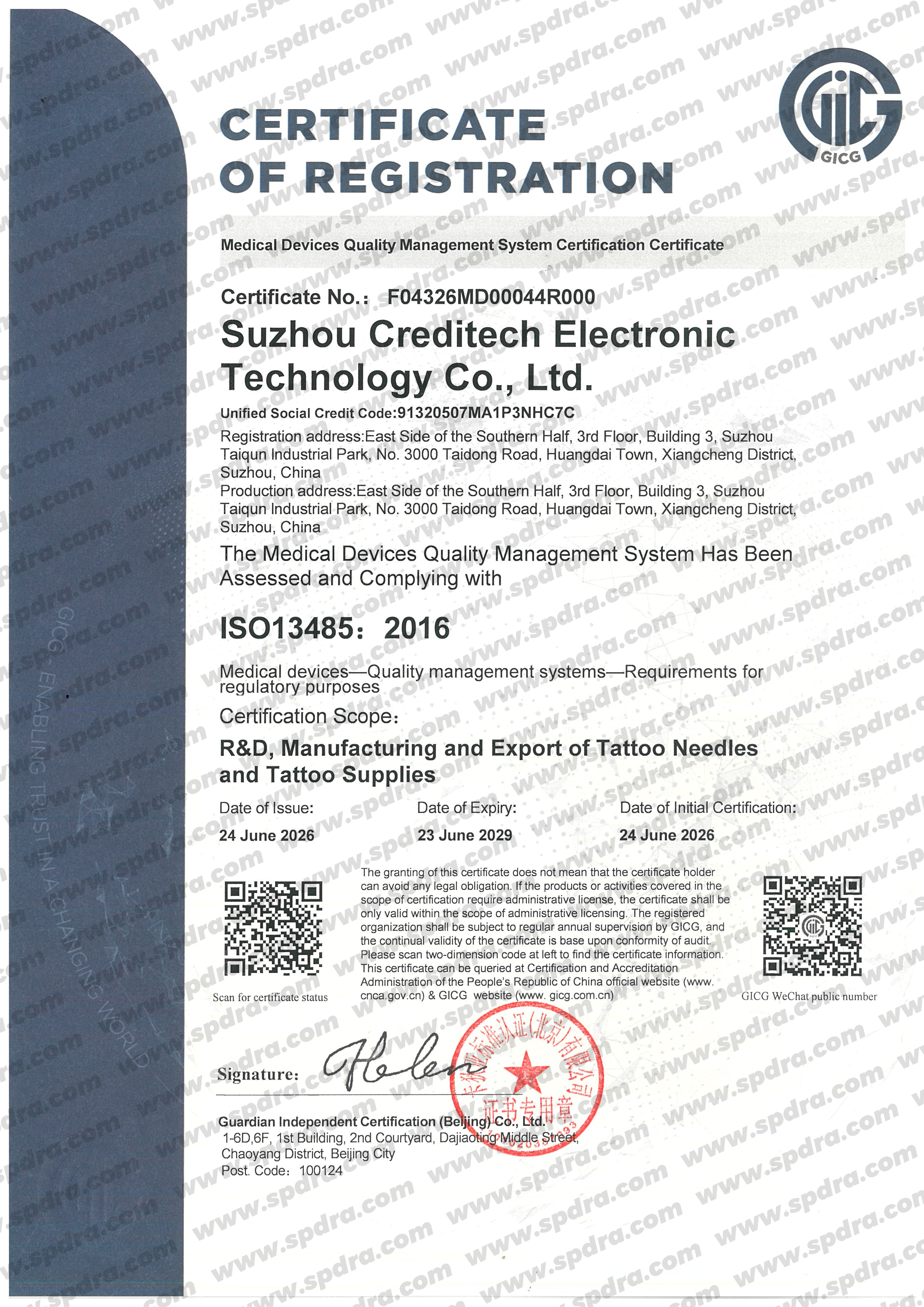
A supplier of medical-grade tattoo needles should hold an ISO 13485:2016 quality management system certificate, and the certified scope is as important as the certificate. CREDITECH MED operates under ISO 13485 certificate F04326MD00044R000, issued by Guardian Independent Certification (Beijing) CO.,LTD., covering Research, Development, Manufacturing & Sales of Tattoo Needles, issued on 24 June 2026 and valid through 23 June 2029.
Three details in that sentence are the actual evaluation: the scope confirms manufacturing and development rather than trading alone; the issuing body is named and can be contacted; and the validity dates can be independently checked. A certificate image without a number, issuer and scope is not evidence.
2. Market-entry documentation for your destination market
Quality system certification is not the same as market documentation. A supplier selling into the EU and the US should be able to present both, and each document should be read for what it actually covers. CREDITECH MED holds a CE MDR document review, reference ICR Polska/DR/HM2311112, issued by ICR Polska Co. Ltd. against MDR (EU) 2017/745 Annex II & Annex III, valid through 29 November 2028. RoHS coverage includes certificate ICR/VC/HM260680 issued by ICR under RoHS (2011/65/EU), valid through 4 June 2031, and report TST2019112501-3RC issued by TST Testing Technology Co., Ltd. under (EU) 2015/863, (EU) 2017/2102 and the full set of IEC 62321 series standards. For the US market, an FDA testing report, reference TST2019112501-4EN, was issued by TST Testing Technology Co., Ltd. under FDA 21CFR175.300, FDA 21CFR180.22, FDA 21CFR181.32, EPA 3050B-1996, ASTM C738-94 and Stainless Steel GRAS. Chemical safety documentation is covered by MSDS certificate BCTC2305199480R, issued by Shenzhen BCTC Testing Co., Ltd. under CLP Regulation (EC) No 1272/2008 and REACH (EC) No 1907/2006.
One clarification that prevents expensive assumptions: a testing report is a laboratory result on a submitted sample, while a certificate is issued against a system or product scope. Both are useful, and neither substitutes for the other. Ask which document your destination market actually requires before treating any of them as a pass.
3. Material specification at component level
Medical-grade is a component-level claim, not a category label. The cartridge construction should be stated part by part: medical-grade stainless steel needles, a medical-grade PC housing, a silicone elastic membrane system, a non-toxic transparent plastic tip, and EO sterilization packaging material. Buyers should request the material declaration for each of these components and check that the declared sterilization method is compatible with the full material set. A vague statement such as medical-grade materials, with no component breakdown, cannot be compared against a competing supplier.
4. Sterilization and packaging integrity
Cartridge needles from this range are EO gas sterilized and supplied in a sterile breathable film packaging system. Four things are worth verifying in writing: the declared sterilization method, whether the packaging system is designed to maintain sterility rather than simply contain the product, whether each unit carries a batch code, and whether the supplier can trace a batch from production through sterilization to shipment. The corresponding quality control statement for CREDITECH MED covers ISO 13485 quality management, 100% inspection, EO sterilization and batch traceability. Each of those four items should be evidenced, not summarised.
5. Manufacturing consistency and capacity
Consistency is measurable. The stated tolerances across the cartridge range are a precision tolerance of ±0.02–0.05 mm, needle diameters of 0.15 mm / 0.20 mm / 0.25 mm / 0.30 mm / 0.35 mm, taper lengths of 1.5 mm to 7 mm with extra-long taper options, and RL / RS / RM / Magnum / Flat configurations, supported by a low-vibration design and a stable controlled ink delivery system. Why these numbers matter by application: 0.15–0.25 mm diameters and long tapers serve fine line, PMU and SMP work, where any drift is visible immediately, while Magnum and flat configurations are used for shading and colour packing, where inconsistent needle alignment produces uneven saturation.
Capacity determines whether a supplier can carry your growth. CREDITECH MED states a monthly capacity of more than 3,000,000 cartridge needles, an annual output of 100,000,000 units, 180 employees including a 20-engineer R&D team, and an export ratio of approximately 90% across Europe, North America, South America and Southeast Asia. Ask whether that capacity is dedicated or shared, and how peak-season demand is scheduled.

6. OEM and ODM customization flexibility
Customization scope is where supplier claims diverge most sharply from supplier capability. The documented categories for CREDITECH MED are custom logo, private label, custom packaging, needle configuration, housing design and new product development. The difficult part of an OEM program is not the logo; it is the handoff from structural design to prototype to mass production. Evaluators should therefore ask who owns the housing design and tooling, who signs off the prototype, and what the minimum order quantity is per size — 500 to 1,000 pcs per size in this case. A supplier that cannot describe that sequence in detail usually cannot execute it.
Step-by-Step Breakdown: A Seven-Step Supplier Vetting Process
Step 1 — Define your market baseline before contacting anyone
Write down the markets you sell into and the documents each market expects. The EU requires RoHS Directive 2011/65/EU compliance and, in practice, MDR-aligned documentation; the US market expects an FDA testing report; global chemical safety disclosure runs through MSDS, REACH and CLP requirements. Without that baseline in advance, every supplier's certificate pack looks equally convincing.
Step 2 — Request the full certification pack, not selected pages
Ask for the ISO 13485 certificate with its scope, the CE MDR document review, RoHS documentation, an applicable FDA testing report, the MSDS, and the component material declaration — with reference numbers and issuing bodies included in the same message. Suppliers that hold valid documentation answer this quickly because the information is already organised.
Step 3 — Cross-check every certificate detail
Verify four things for each document: the reference number, the issuing body, the certified scope, and the validity period. A scope limited to sales describes a trading company rather than a manufacturer. A validity period that has lapsed invalidates the claim regardless of how the file is presented. Check that the standard version cited matches the current version — ISO 13485:2016, for example.
Step 4 — Audit material and sterilization declarations against the physical product
Compare the declared component list — needles, housing, membrane, tip, packaging material — against the sample you receive. If backflow control is part of your requirement, confirm the presence of the silicone anti-backflow membrane in the specification, not only in the brochure. Confirm that the sterilization method printed on the packaging label matches the documentation you were sent.
Step 5 — Test samples against a written protocol
Define pass and fail criteria before the box is opened: line consistency at fine line diameters, membrane backflow behaviour, ink flow stability, vibration level in your own grip, cartridge-to-grip fit, and sterile barrier integrity after transit. Test more than one batch code; a single good batch demonstrates nothing about consistency, which is precisely what a distributor's repeat order depends on.
A practical scoring habit: score each supplier on the four pillars — documentation, materials and sterilization, OEM/ODM capability, and commercial terms — and record the evidence next to each score. A supplier that scores well on price but cannot produce a scope-verified ISO 13485 certificate is not the cheaper option at scale.
Step 6 — Pressure-test the OEM/ODM path
Ask for the development sequence in your own terms: concept, structural design, prototype, packaging design, mass production. Identify what the supplier owns and what you must supply. Confirm the minimum order quantity per size, the sample development time, and whether batch traceability continues into private-label production — because private label is exactly where traceability is most often lost.
Step 7 — Model commercial terms and supply continuity
Standard orders run 15–30 days, and custom OEM orders run 30–45 days, with an MOQ of 500–1,000 pcs per size. Against those terms, test capacity headroom of more than 3,000,000 units per month and the supplier's operating experience in your region: export markets for this supplier include the USA, Germany, the UK, France, Brazil, Mexico, Colombia, Canada and Australia. Then ask the continuity questions that decide a second-year relationship: how peak season is scheduled, how repeat orders are prioritised, and what technical and after-sales support exists once the goods have shipped.

Use Cases: How the Framework Plays Out in Real Buying Situations
Private-label brand scaling an OEM line
A Mexico-based private-label brand has worked with CREDITECH MED for five years, with a volume of more than 3,000,000 cartridge needles per year, custom housing design, and sales through tattoo supply distribution and e-commerce, recording stable quality, long-term supply and consistent performance. The evaluation points in that case are the ones a framework should surface: OEM development, private label, fast sample development, stable supply chain and batch traceability. For a brand owner, the vetting question is not whether a logo can be printed, but whether the design and the supply can be held for five consecutive years.
Tattoo and PMU wholesaler serving studios
A Spain-based tattoo and PMU supply wholesaler has maintained a five-year supply relationship covering professional tattoo studios and permanent makeup applications, again built on OEM development, private label, fast sample development, stable supply chain and batch traceability. For wholesalers the decisive criterion is the second and third order, not the first: repurchase rate and consistent performance are what protect the wholesaler's own reputation with studios.
PMU and SMP-focused buyers
Permanent makeup and scalp micropigmentation work demands tighter control than general tattooing: finer diameters, longer tapers and highly consistent single-needle behaviour. Buyers in this segment should verify configuration availability alongside certification. CREDITECH MED supplies PMU and SMP cartridges through its ESTLIA brand, which is dedicated to PMU and SMP cartridges engineered for fine detail work, safety and cosmetic precision procedures, and the same ISO 13485 certified quality system applies across the range.
Multi-region distributors
A distributor selling into both the EU and the US needs one supplier that can produce both document sets without renegotiation. The check is straightforward: confirm that MDR-aligned documentation and the FDA testing report exist, and that each document references the products you are actually purchasing. Where a supplier holds one but not the other, the distributor absorbs the compliance gap.
Comparison Table: Documented Certification Evidence
The table below summarises the certification and testing documentation held for this tattoo cartridge needle range. Each entry can be verified with the issuing body using the reference number.
| Certification / Report | Reference Number | Issuing Body | Market | Standard | Validity |
|---|---|---|---|---|---|
| ISO 13485 | F04326MD00044R000 | Guardian Independent Certification (Beijing) CO.,LTD. | Global | ISO 13485:2016 | 24 Jun 2026 – 23 Jun 2029 |
| CE MDR Document Review | ICR Polska/DR/HM2311112 | ICR Polska Co. Ltd. | EU | MDR (EU) 2017/745 Annex II & Annex III | 30 Nov 2023 – 29 Nov 2028 |
| RoHS (2011/65/EU) | ICR/VC/HM260680 | ICR | EU | RoHS (2011/65/EU) | 5 Jun 2026 – 4 Jun 2031 |
| RoHS 2.0 | TST2019112501-3RC | TST Testing Technology Co., Ltd. | EU | (EU) 2015/863, (EU) 2017/2102, IEC 62321 series | Issued 3 Dec 2019 |
| FDA Testing Report | TST2019112501-4EN | TST Testing Technology Co., Ltd. | USA | FDA 21CFR175.300, 21CFR180.22, 21CFR181.32, EPA 3050B-1996, ASTM C738-94, Stainless Steel GRAS | Issued 3 Dec 2019 |
| MSDS | BCTC2305199480R | Shenzhen BCTC Testing Co., Ltd. | Global (EU & USA) | CLP Regulation (EC) No 1272/2008; REACH (EC) No 1907/2006 | Issued 17 May 2023 |
Supplier Response Scorecard: Strong Answers Versus Weak Answers
Use the same five prompts with every supplier and record the evidence, not the impression.
| Evaluation Area | Strong Answer | Weak Answer |
|---|---|---|
| Quality system | ISO 13485:2016 certificate with a manufacturing and development scope, named issuer, reference number and validity dates | Undated certificate image, or a general statement about being a certified factory |
| Market documentation | CE MDR document review, RoHS documentation, FDA testing report and MSDS with reference numbers and issuing bodies | One certificate offered as covering all markets, or documents without numbers |
| Materials and sterilization | Component-level material list plus declared EO gas sterilization and sterile breathable film packaging | Medical-grade claimed as a category, with no component breakdown or sterilization statement |
| Consistency | Stated precision tolerance, needle diameter and taper range, configuration list, 100% inspection and batch traceability | Claims about precision with no numbers, and no batch coding on the sample |
| Commercial terms | Named production capacity, MOQ per size, standard and custom lead times, and a verifiable OEM programme history | Quotation without a locked specification, or OEM described only as logo printing |

FAQ
What certifications should a sterile tattoo cartridge needle manufacturer be able to show?
A workable baseline is an ISO 13485:2016 quality management system certificate whose scope covers the research, development and manufacturing of tattoo needles, not sales alone. Market-specific documentation sits on top of that baseline: for the EU, CE MDR documentation reviewed against MDR (EU) 2017/745 Annex II & Annex III and RoHS compliance; for the US, an FDA testing report; and globally, an MSDS covering REACH and CLP requirements. CREDITECH MED, for example, holds ISO 13485 certificate F04326MD00044R000 issued by Guardian Independent Certification (Beijing) CO.,LTD., CE MDR document review ICR Polska/DR/HM2311112 issued by ICR Polska Co. Ltd., RoHS documentation ICR/VC/HM260680 and TST2019112501-3RC, FDA testing report TST2019112501-4EN issued by TST Testing Technology Co., Ltd., and MSDS BCTC2305199480R issued by Shenzhen BCTC Testing Co., Ltd. The evaluation step is not collecting these documents, but checking each reference number, issuing body, scope and validity date.
How can a buyer tell whether a supplier's OEM and ODM capability is real?
Test it against a defined scope rather than a general claim. Ask the supplier to name exactly what it customizes — custom logo, private label, custom packaging, needle configuration, housing design and new product development are the standard categories — and then ask who owns the structural design, the tooling and the prototype-to-production handoff. Confirm a per-size minimum order quantity, a monthly production capacity, and at least one verifiable programme. A CREDITECH MED private-label programme with a Mexico-based brand, for instance, has run for five years at more than 3,000,000 cartridge needles per year with custom housing design. Suppliers that only print logos generally cannot answer the design, tooling and tolerance questions.
What actually drives the unit cost of tattoo cartridge needles?
Unit cost is determined by specification before it is determined by negotiation. The main drivers are needle material and housing material grade, the silicone anti-backflow membrane system, the EO gas sterilization process, the sterile breathable film packaging system, tolerance control through 100% inspection at a precision tolerance of ±0.02–0.05 mm, configuration complexity across RL / RS / RM / Magnum / Flat, and commercial terms such as an MOQ of 500–1,000 pcs per size and the applicable lead time. Comparing two quotations without matching those variables produces a number that cannot be used for a real purchasing decision.
How should a sample evaluation be structured?
Structure it as a written test rather than an impression. Select one or two configurations and diameters — for example 0.15–0.25 mm for fine line, PMU or SMP work — then verify membrane and ink flow behaviour, check low-vibration performance in your own grip, and inspect the sterile breathable film packaging and batch code on arrival. Test samples from more than one production batch, because consistency, not single-sample quality, is the supplier variable that affects repurchase rates. Suppliers with genuine OEM development capability typically support fast sample development, so the sample reflects the production specification rather than a hand-built unit. To start a sample evaluation with CREDITECH MED, request a sample or a quotation by email at estlia@creditechmed.com or by WhatsApp on +86 18625276381, or review the full range at creditechmed.com.
What MOQ and lead times are typical for cartridge needle orders?
For CREDITECH MED, standard orders run 15–30 days and custom OEM orders run 30–45 days, with an MOQ of 500–1,000 pcs per size. Before committing to a schedule, confirm the supplier's capacity headroom — more than 3,000,000 cartridge needles per month in this case — and confirm that batch traceability continues through private-label production. Lead time commitments should always be tied to a locked specification, because a change in needle diameter, taper length or packaging after ordering resets the production timeline.
Conclusion: Evidence First, Price Second
Evaluating a tattoo cartridge needle supplier is a documentation exercise with a commercial finish. Four pillars decide the outcome: a quality management system that can be verified by reference number, issuer and scope; market documentation that matches the markets you actually sell into; material and sterilization control that reaches component level, including EO gas sterilization and sterile breathable film packaging; and an OEM/ODM capability that includes structural design, housing development and batch traceability, not just logo printing. Commercial terms — capacity, MOQ and lead time — should be modelled last, against a specification that all suppliers are quoting on equally.
Applied consistently, this framework does two things at once: it removes the suppliers that cannot be scaled, and it gives you a defensible file for every purchasing decision you make.
Evaluate the supplier with documents in hand
CREDITECH MED supplies ISO 13485 certified tattoo cartridge needles, PMU cartridges and SMP cartridges from a manufacturing facility in Suzhou, China, with OEM and ODM programmes covering custom logo, private label, custom packaging, needle configuration and housing design.
Next step: request a sample or a specification-matched quotation — email estlia@creditechmed.com or WhatsApp +86 18625276381. Download the full product brochure and certification overview here: CREDITECH MED company brochure. Website: https://www.creditechmed.com.
Have Questions or Need More Details?
Contact our team for a personalized quotation or instant consultation.
Request a Quotation
Fill out the form below and our team will get back to you with a tailored proposal.
WhatsApp Direct Chat
Prefer to chat in real-time? Message us on WhatsApp for instant assistance & quick answers.
- Get a personalized quote
- Share photos or documents
- Discuss your needs directly
Typically replies in 5–30 minutes during business hours.