
Tattoo Cartridge Needle: Anatomy, Needle Counts, and What Medical-Grade Manufacturing Actually Means
A tattoo cartridge needle is a single-use, pre-assembled needle configuration housed inside a sterile plastic cartridge that screws or slides onto a rotary tattoo machine. For professional tattoo artists, PMU specialists, SMP clinicians, and private-label brands, the cartridge needle is not an accessory; it is the core tool that controls ink delivery, skin trauma, and final line quality. This guide explains the anatomy, configuration logic, sterilization process, and medical-grade manufacturing standards that separate a consistent cartridge from one that causes inconsistent results.
Why Tattoo Cartridge Needles Replaced Traditional Bar Needles
The shift from traditional bar needles to cartridge needles reflects a broader move toward safety, efficiency, and consistency in the tattoo industry. Industry estimates indicate that roughly 73% of professional tattoo artists preferred needle cartridges over traditional bar needles by 2024, citing ease of use and safety as primary reasons. Cartridge needles are also the largest product type segment in the global tattoo needle market, largely because of their sterility and compatibility with modern rotary machines.
Cartridge needles eliminate several steps that were previously manual: attaching a needle to a bar, aligning its depth, and adjusting the machine setup. A pre-assembled cartridge needle provides a fixed needle depth, a sealed ink chamber, and a disposable barrier between the artist and the needle. This makes rotation between clients faster and reduces cross-contamination risk in studios that perform multiple sessions per day.
Tattoo Cartridge Needle Anatomy and Components
Understanding the components of a tattoo cartridge needle helps users evaluate suppliers, compare technical specifications, and troubleshoot when a cartridge does not perform as expected. A typical professional cartridge needle is built around four primary elements:
- Needle group: Multiple medical-grade stainless steel needles arranged in a precise configuration such as Round Liner (RL), Round Shader (RS), Round Magnum (RM), Magnum, or Flat. Needle diameter determines the size of the puncture and influences ink flow.
- Cartridge housing: A medical-grade polycarbonate (PC) body that holds the needle group in alignment. The housing is designed to fit standard rotary tattoo machines and cartridge grips.
- Membrane system: A silicone elastic anti-backflow membrane that sits between the ink chamber and the needle group. It prevents ink and fluid from flowing backward into the machine, which is critical for hygiene and consistent ink delivery.
- Tip: A non-toxic transparent plastic tip that guides needle penetration and allows the artist to see the needle during work.
In finer detail, the needle group is manufactured with precision tolerance of ±0.02–0.05mm in professional-grade cartridges. This tolerance range keeps needle tips aligned when grouped, which directly affects whether a liner deposits consistent lines and whether a shader produces smooth saturation.
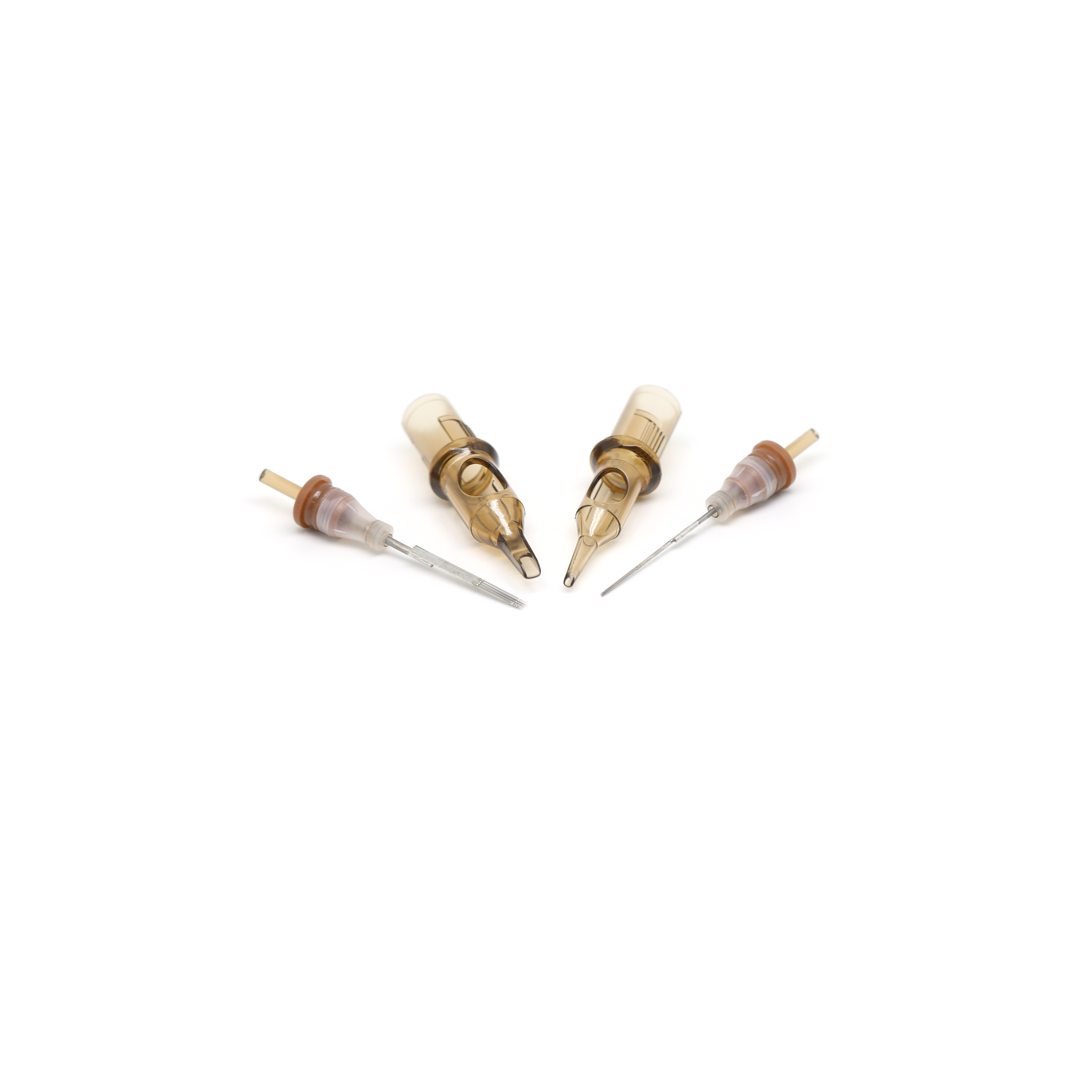
HM3 tattoo cartridge needle: a professional cartridge with silicone anti-backflow membrane system.
Key Parameters: Needle Diameter, Taper Length, and Configuration
Three parameters determine how a cartridge needle performs in a specific application: needle diameter, taper length, and needle configuration. These parameters are not interchangeable; each affects skin response, ink flow, and the final visual result.
Needle Diameter
Common needle diameters for professional tattoo cartridges are 0.15mm, 0.20mm, 0.25mm, 0.30mm, and 0.35mm. Thinner needles such as 0.15mm and 0.20mm are used for fine line work, micro-detail, and PMU procedures that require minimal tissue trauma. Thicker needles such as 0.30mm and 0.35mm are more common for color packing, shading, and bold linework.
Taper Length
Taper length refers to the grinding section of the needle where it narrows to a point. In the SPACEDRAGON product line, taper length ranges from 1.5mm to 7mm, with extra long taper available. Short tapers (1.5–2.5mm) produce sharper entry and are preferred for crisp lines and precision work. Long tapers (4mm and above) allow more ink to be carried into the skin and are often chosen for smooth shading and soft color blending.
Configuration
Configuration describes how individual needles are arranged inside the cartridge. The main configuration options are:
| Configuration | Typical Use |
|---|---|
| RL (Round Liner) | Lining, lettering, fine outlines, precise detail |
| RS (Round Shader) | Small-area shading, blending, soft color transitions |
| RM (Round Magnum) | Shading and color packing with a softer edge than standard magnums |
| Magnum | Large-area shading, color packing, smooth gradients |
| Flat | Bold lines, precise corners, crisp geometric work |
These configurations are used across single-needle fine line cartridges, 3RL, 5RL, 7RL liner cartridges, 5RS, 7RS shader cartridges, 5M1, 7M1 magnum cartridges, and specialized PMU and SMP needle configurations.
Sterile Tattoo Cartridge: How Sterilization Works
Sterility is one of the most important requirements for tattoo cartridge needles. A tattoo needle penetrates the skin, so any contamination can introduce pathogens into the client. A sterile tattoo cartridge is designed to be opened immediately before use and discarded after a single session.
The sterilization method used by CREDITECH MED is ethylene oxide (EO) gas sterilization. EO sterilization is compatible with the cartridge's plastic and silicone components and does not damage needle sharpness. After sterilization, each cartridge is packaged in a sterile breathable film packaging system. The breathable film allows the sterilizing gas to escape after the process and maintains the sterile barrier during storage and transport.
For buyers, verifying the sterilization process is as important as verifying the product specification. A sterile tattoo cartridge supplier should provide clear information about its sterilization method, packaging, and quality management system.
ISO 13485 Certified Tattoo Needle: The Regulatory Standard
ISO 13485 is the international standard for quality management systems for medical devices. It is not a product certificate; it is an audited management system that ensures a manufacturer maintains consistent processes for design, production, storage, and traceability. For medical-grade tattoo needle production, ISO 13485 certification signals that the manufacturer has a controlled system for quality, documentation, risk management, and corrective actions.
Suzhou Creditech Electronic Technology Co., Ltd. operates under an ISO 13485 certified quality management system. The company also states that its products are CE compliant and that FDA test reports are available for applicable products. For professional buyers, these credentials matter because they reduce the burden of supplier qualification and provide a baseline for regulatory documentation.
Contact CREDITECH MED to request certifications, sterilization documentation, or product samples.
Medical-Grade Tattoo Needle Manufacturing in China: What a 100-Million-Unit Facility Looks Like
Medical-grade tattoo needle manufacturing involves precision grinding, electro-polishing, assembly, inspection, and sterile packaging. China is a major global supplier of tattoo needles and medical instruments. In May 2026 alone, Chinese exports of medical instruments including needles reached approximately USD 1.19 billion, with the United States as the largest destination.
Suzhou Creditech Electronic Technology Co., Ltd., founded in 2009, is a manufacturer in this export ecosystem. The company operates a 3,000 m² manufacturing facility with an annual production capacity of 100,000,000 units. Approximately 180 staff support production, with a dedicated R&D team of 20 engineers. Around 90% of the company's output is exported, serving markets in Europe, North America, South America, and Southeast Asia.
For a buyer evaluating a potential tattoo needle cartridge manufacturer, the manufacturing scale matters in two ways. First, it affects supply stability: a larger facility with automated assembly lines can handle volume orders and reorders consistently. Second, it affects customization capability: OEM and ODM programs require engineering resources for structural design, prototyping, testing, and packaging development.

A packaging line dedicated to sterile breathable film packaging of tattoo cartridge needles.
OEM and ODM Tattoo Needle Manufacturing
Many tattoo brands, distributors, and PMU training academies do not manufacture their own cartridges; they source under their own label. OEM (Original Equipment Manufacturing) means the buyer provides the design and the manufacturer produces it to specification. ODM (Original Design Manufacturing) means the manufacturer designs the product and the buyer customizes branding, packaging, and selected specifications.
CREDITECH MED offers both OEM and ODM services covering product development, structural design, prototyping, mass production, and customized packaging. A distributor with a brand identity can start from an existing cartridge model, choose needle configurations, and add private-label packaging. A more ambitious brand can request structural changes, new needle grouping, or a customized membrane system, provided the engineering team has the capacity to develop it.
For tattoo cartridge needle OEM projects, buyers should prepare the following information:
- Target configurations (RL, RS, RM, Magnum, Flat) and needle counts
- Required needle diameter and taper length
- Packaging format and branding language
- Compliance requirements for the destination market
- Estimated order volume and delivery schedule
PMU Cartridge Needles and SMP Cartridge Needles
Permanent makeup (PMU) and scalp micropigmentation (SMP) have different technical requirements than traditional tattooing. PMU procedures such as eyebrow tattoos, lip blush, and eyeliner require extremely fine needles, precise depth control, and minimal tissue trauma. SMP procedures require needles that can implant pigment into the scalp at a consistent depth over a large area.
The global permanent makeup market was valued at USD 162.09 million in 2025, with a forecasted 8.12% CAGR for the needle-heavy microblading segment. This growth increases demand for PMU cartridge needles, eyebrow tattoo needles, and cosmetic tattoo needles that are designed for controlled pigment delivery.
CREDITECH MED develops PMU and SMP cartridges under the ESTLIA brand, which focuses on fine detail work, safety, and precision procedures. PMU eyebrow needles and SMP cartridge needles are available in sterile packaging and use the same medical-grade materials as the company's tattoo cartridges. For a PMU studio or an SMP clinic, choosing a cartridge needle designed specifically for cosmetic procedures is safer than adapting a traditional tattoo cartridge.
How to Evaluate a Tattoo Cartridge Needle Supplier
Professional buyers evaluating tattoo cartridge needle suppliers should use a structured checklist that covers product quality, regulatory compliance, manufacturing transparency, and long-term supply reliability. The following factors are the most decisive:
- ISO 13485 certification: Confirms that the quality management system is reviewed and audited against a recognized medical-device standard.
- Sterilization and packaging documentation: EO sterilization and sterile breathable film packaging should be clearly stated and verifiable.
- Material traceability: Medical-grade stainless steel for needles and medical-grade PC for housing are the expected standards.
- Precision control: A tolerance range of ±0.02–0.05mm is a reasonable benchmark for professional cartridges.
- OEM/ODM capability: An engineering team with prototyping capability protects a brand's ability to differentiate.
- Production capacity and export experience: These indicate whether the supplier can handle volume orders, seasonal peaks, and geographic regulatory requirements.
Comparing Supplier Types
| Criteria | Factory-Direct Manufacturer | Trading Company | Distributor / Reseller |
|---|---|---|---|
| ISO 13485 certified production | Directly controlled | Depends on factory | Depends on factory |
| OEM / ODM development | Engineers on site | Limited | Not available |
| Sterilization verification | Factory records | Indirect | Minimal |
| Custom packaging | Available | Often limited | No |
| Supply stability | High for large volume | Medium | Medium |
Tattoo Cartridge Needle Applications
The following table summarizes where different cartridge needle types are commonly used across the tattoo, PMU, and SMP industries.
| Application Area | Common Needle Types | Typical Users |
|---|---|---|
| Fine Line Tattooing | Fine line tattoo needles, 1RL, 3RL, long taper needles | Professional tattoo artists specializing in fine line and realism |
| Shading and Color Packing | Magnum tattoo needles, shader tattoo needles, RS, RM | Artists working on large-scale color projects |
| PMU / Cosmetic Tattooing | PMU cartridge needles, eyebrow tattoo needles, cosmetic tattoo needles | PMU salons, beauty training academies |
| SMP Clinics | SMP cartridge needles, scalp micropigmentation needles | SMP practitioners treating scalp conditions |
| OEM / Private Label | OEM ODM tattoo needle configurations | Distributors, brands, and e-commerce retailers |
CREDITECH MED: A Factory Example
Suzhou Creditech Electronic Technology Co., Ltd. is a China-based manufacturer specializing in tattoo cartridge needles, PMU cartridges, and tattoo consumables. The company was established in 2009 and operates from Suzhou, a manufacturing hub in the Yangtze River Delta. Under its production system, the company runs a 3,000 m² facility, employs about 180 people, and maintains an annual output capacity of 100 million units.
The company has created three specialized brands to serve different industry areas:
- SPACEDRAGON TATTOO — the flagship brand for professional tattoo cartridge needles, focused on precision, stability, and performance.
- ESTLIA — a brand dedicated to PMU and SMP cartridges for cosmetic precision procedures.
- LPT Tattoo Supply — a diversified brand for everyday studio supplies and consumables.
In the product range, models such as HM3, HM6, SP4, SP5, and SP6 cover fine line cartridges, shaders, magnums, PMU eyebrow needles, and SMP cartridge needles. All models share the same underlying production standards: medical-grade stainless steel needles, medical-grade PC housing, silicone anti-backflow membrane, EO gas sterilization, and sterile breathable film packaging.

Inside the CREDITECH MED cartridge needle assembly workshop.
Regulatory Compliance for Sterile Tattoo Cartridges
Medical-grade tattoo needles are subject to regulatory expectations in multiple markets. The ISO 13485 certification applies to the quality management system of the manufacturer. In the European Union, tattoo needle cartridges must also comply with the RoHS Directive 2011/65/EU, which restricts hazardous substances in electrical and electronic equipment. EN IEC 63000:2018 is often referenced for hazardous substance assessment.
For a buyer, this means a compliant supplier should be able to provide more than a product photo. They should be able to explain how their quality management system aligns with ISO 13485, whether their products are CE compliant, whether FDA test reports are available, and how they manage material compliance. CREDITECH MED states that its products are CE compliant and that FDA test reports are available for applicable products.
Single-Use Tattoo Cartridge: Why Reuse Is Not an Option
Single-use tattoo cartridges are designed for one procedure on one client. Reusing a cartridge violates the basic principle of sterile tattooing, even if the cartridge is cleaned on the outside. Blood, ink, and tissue fluid can remain in the needle group and membrane system, creating a contamination risk for both artists and clients.
The single-use design also explains why packaging matters. A sterile package should remain intact until the moment of use, and the cartridge should click into the machine without touching the needle group. Professional cartridge systems achieve this with a sealed membrane tip that opens as the artist begins working.
Technical Comparison: Tattoo Cartridge Needle Models at CREDITECH MED
The company publishes a consistent set of specifications for its cartridge needles across the HM3, HM6, SP4, SP5, and SP6 models. The following table summarizes the common technical baseline for these models.
| Parameter | Specification Range |
|---|---|
| Needle diameter | 0.15mm / 0.20mm / 0.25mm / 0.30mm / 0.35mm |
| Taper length | 1.5mm–7mm, extra long taper available |
| Configuration | RL / RS / RM / Magnum / Flat |
| Membrane system | Silicone anti-backflow membrane |
| Compatibility | Rotary tattoo machines |
| Sterilization | EO gas sterilized |
| Precision tolerance | ±0.02–0.05mm |
| Ink flow | Stable controlled ink delivery system |
| Vibration | Low vibration design |
| Packaging | Sterile breathable film packaging system |
FAQ
What is a tattoo cartridge needle supplier and what should they provide?
A tattoo cartridge needle supplier is a company that manufactures or distributes pre-assembled, single-use needle cartridges for tattoo, PMU, and SMP machines. A professional supplier should provide documented quality control, a defined sterilization method such as EO gas sterilization, sterile packaging, material specifications, and ideally an ISO 13485 certified quality management system. Buyers should also look for suppliers that can provide consistent supply volume and clear communication for reorders.
What is the difference between a liner and a shader tattoo cartridge needle?
A liner cartridge needle, typically a Round Liner (RL), is designed to deposit a crisp, concentrated line of ink. Liner cartridges usually have tightly packed needles that penetrate the skin in a small area. A shader cartridge needle, typically a Round Shader (RS) or Magnum, is designed to cover larger areas with softer saturation and smoother color transitions. Shader needles are generally grouped with more space between them to carry more ink.
How do I choose between fine line, shader, and magnum tattoo cartridge needles?
Choose fine line tattoo needles when you need thin lines, delicate details, or PMU and SMP procedures. Choose shader tattoo needles for small to medium shading areas and soft blending. Use magnum tattoo needles for large shading areas, color packing, and smooth gradients. The choice depends not on brand preference but on the visual effect you need to create and the skin area you are working on.
What does a medical-grade tattoo needle standard include?
A medical-grade tattoo needle standard includes the use of medical-grade stainless steel for needle shafts, medical-grade polycarbonate for the housing, a silicone anti-backflow membrane system, and controlled manufacturing with verified precision tolerance. In practice, an ISO 13485 certified quality management system is widely treated as evidence that a manufacturer maintains consistent processes for design, production, and traceability. RoHS compliance is also relevant for products sold in the EU.
Can I get an OEM or ODM tattoo cartridge needle for my brand?
Yes. OEM and ODM tattoo needle manufacturing is a common route for tattoo supply brands, distributors, and private-label retailers. In an OEM program, a manufacturer produces your design to specification. In an ODM program, the manufacturer offers an existing design that can be customized with your branding, packaging, and needle configuration choices. CREDITECH MED provides OEM and ODM services covering product development, structural design, prototyping, mass production, and customized packaging.
What are the typical lead times for tattoo cartridge needle samples and mass production?
Lead time depends on whether the needle configuration is a standard stock item or a custom project. Standard products from a manufacturer with high production capacity can usually be sampled faster than fully custom designs. Custom OEM/ODM projects require additional time for prototyping, testing, and packaging development. Buyers should always confirm sample lead time and production lead time with the supplier before placing an order.
Conclusion
Choosing the right tattoo cartridge needle is a technical decision. The needle diameter, taper length, configuration, membrane system, sterilization method, and manufacturing quality system all affect the final result. For individual artists, the priority is choosing a cartridge that matches their line style and work speed. For brands, distributors, and studios buying at scale, the priority is choosing a manufacturer with audited quality systems, stable production capacity, and the ability to support private-label programs.
Suzhou Creditech Electronic Technology Co., Ltd. offers a factory-direct example of this standard: ISO 13485 certified production, EO sterilized cartridges, sterile breathable film packaging, a 100-million-unit annual capacity, and OEM/ODM support under its SPACEDRAGON, ESTLIA, and LPT Tattoo Supply brands. For buyers moving from product awareness to supplier evaluation, requesting samples and reviewing technical documentation is the logical next step.
Request a quote or catalog from CREDITECH MED.
Email: estlia@creditechmed.com
Phone / WhatsApp: +86 18625276381
Have Questions or Need More Details?
Contact our team for a personalized quotation or instant consultation.
Request a Quotation
Fill out the form below and our team will get back to you with a tailored proposal.
WhatsApp Direct Chat
Prefer to chat in real-time? Message us on WhatsApp for instant assistance & quick answers.
- Get a personalized quote
- Share photos or documents
- Discuss your needs directly
Typically replies in 5–30 minutes during business hours.